Using long-term data to inform the climate-vegetation relationship
The possibility that tropical rainforests, such as the Amazon, could be nearing a tipping point triggering widespread forest loss has garnered considerable attention during recent years. This type of large-scale forest loss, or regime shift, occurs when climate and environmental conditions can support both forest and savanna biomes as alternate states. Climate-vegetation-disturbance feedbacks, such as differing vegetation-mediated fire regimes, maintain distinct biomes in similar environmental conditions. For instance, savanna vegetation promotes more intense and frequent fire disturbances, allowing fire-tolerant savanna species to persist while fire-intolerant forest species are excluded from the system. Meanwhile, in the forest biome, forest vegetation reduces the frequency and intensity of fires, allowing fire-intolerant forest species to outcompete savanna species.
Unfortunately, both the extent to which forests and savannas occur as alternate states (rather than being climatically determined) and the relationship between climate change, feedbacks, and vegetation change are poorly understood, leading to high uncertainty in predictions of tropical forest loss. This is because (1) the response of vegetation to climate and the development of feedbacks occur over centuries, and (2) there are few instances of terrestrial regime shifts in the modern observational record. I use the Upper Midwest, USA as a study system for investigating the drivers of biome distributions and tree community composition. The Upper Midwest offers a great opportunity for addressing questions related to savanna-forest vegetation dynamics for a few reasons. First, the region supported both savanna and forest prior to EuroAmerican settlement, after which the savanna biome all but disappeared from the landscape. Second, we have rich historical and paleoecological records.
I showed that climate, topographic, and edaphic variables are unable to fully explain both the geospatial distribution of biomes and the tree communities they support, and change in vegetation over time (Willson et al. in review & Shuman et al. in review. Furthermore, after accounting for environmental conditions, residual correlations remain between species that are characteristic of the forest and savanna biomes. These residual correlations indicate that our models did not include a variable explaining patterns in community composition and biome distributions. Through a series of statistical models, I demonstrate that feedbacks, such as differing vegetation-mediated fire regimes, are a plausible explanation for what is missing from our models. This research is currently in review–please check back for updates!
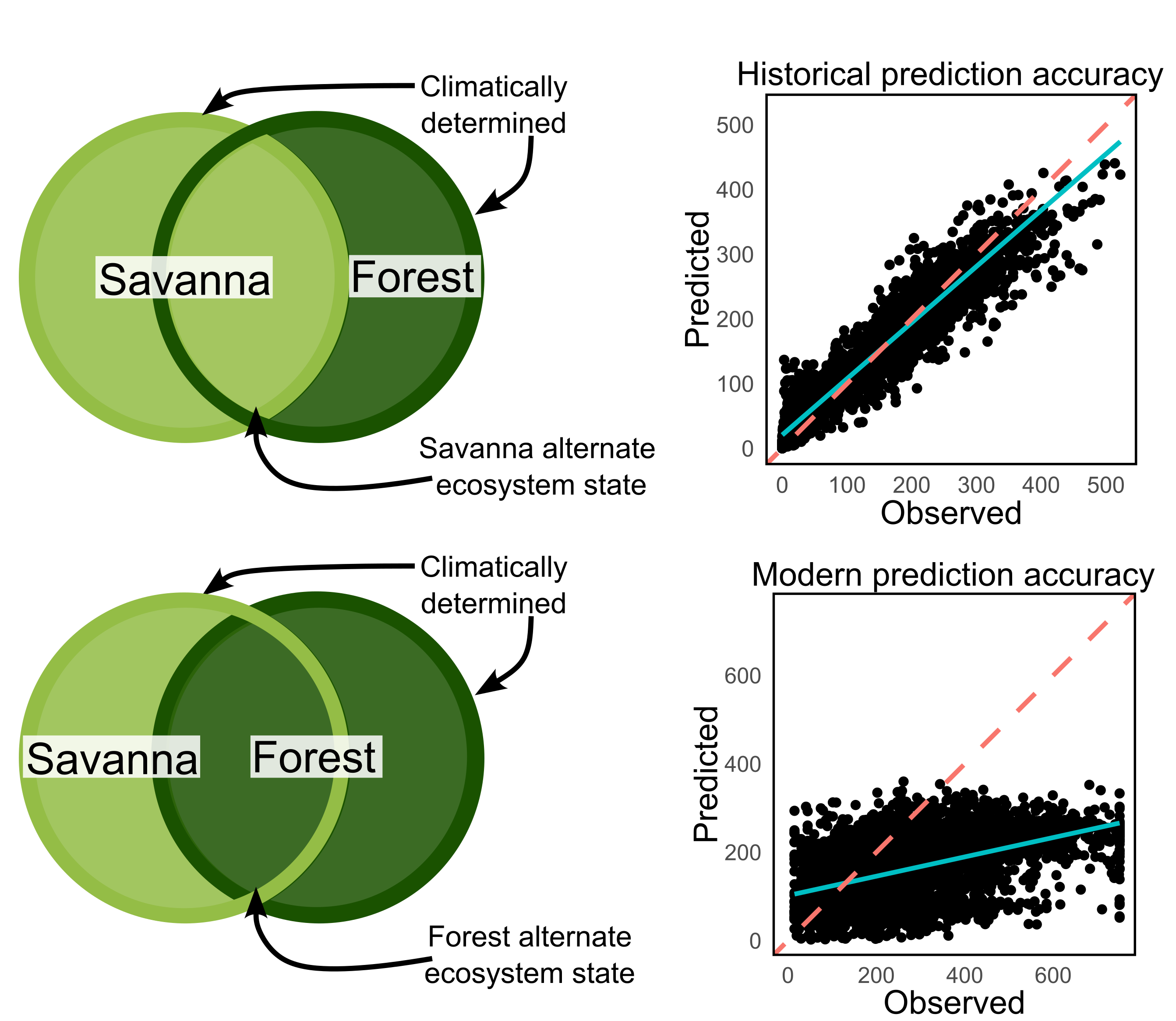
A common approach to predicting how biome distributions will change in the future is using correlative species distribution models. However, these models assume that vegetation-environment-disturbance feedbacks are negligible. If these feedbacks are important drivers of vegetation change, then these models will lead to inaccurate predictions, and may miss non-linear vegetation change, such as regime shifts in tropical forests. To demonstrate the consequences of ignoring feedbacks in these popular models, I fit species distribution models to the relationship between vegetation and environmental conditions prior to EuroAmerican settlement. Then, I compared the accuracy of my models predicting out-of-sample historical vegetation and the same locations on the modern landscape, since EuroAmerican settlement. I showed that the models were accurate during the historical period, but highly inaccurate in the modern period. This is because the loss of the savanna biome since EuroAmerican settlement could not be explained by change in climate alone.