
Model-data fusion as hypothesis testing
Mechanistic models are powerful tools for forecasting terrestrial ecosystems because, by combining theory and empirical research, they can make quantitative predictions even under conditions that have no historical analog (Malmborg et al. 2024). However, model predictions can be inaccurate… As the old adage goes, “All models are wrong but some are useful.” I confront model predictions with empirical data to both improve decision-relevant forecasts of terrestrial ecosystems and test ecological hypotheses. While it’s commonly recognized that models represent our hypotheses about ecological functioning, using model-data fusion as a method for testing and refining ecological hypotheses remains relatively uncommon.
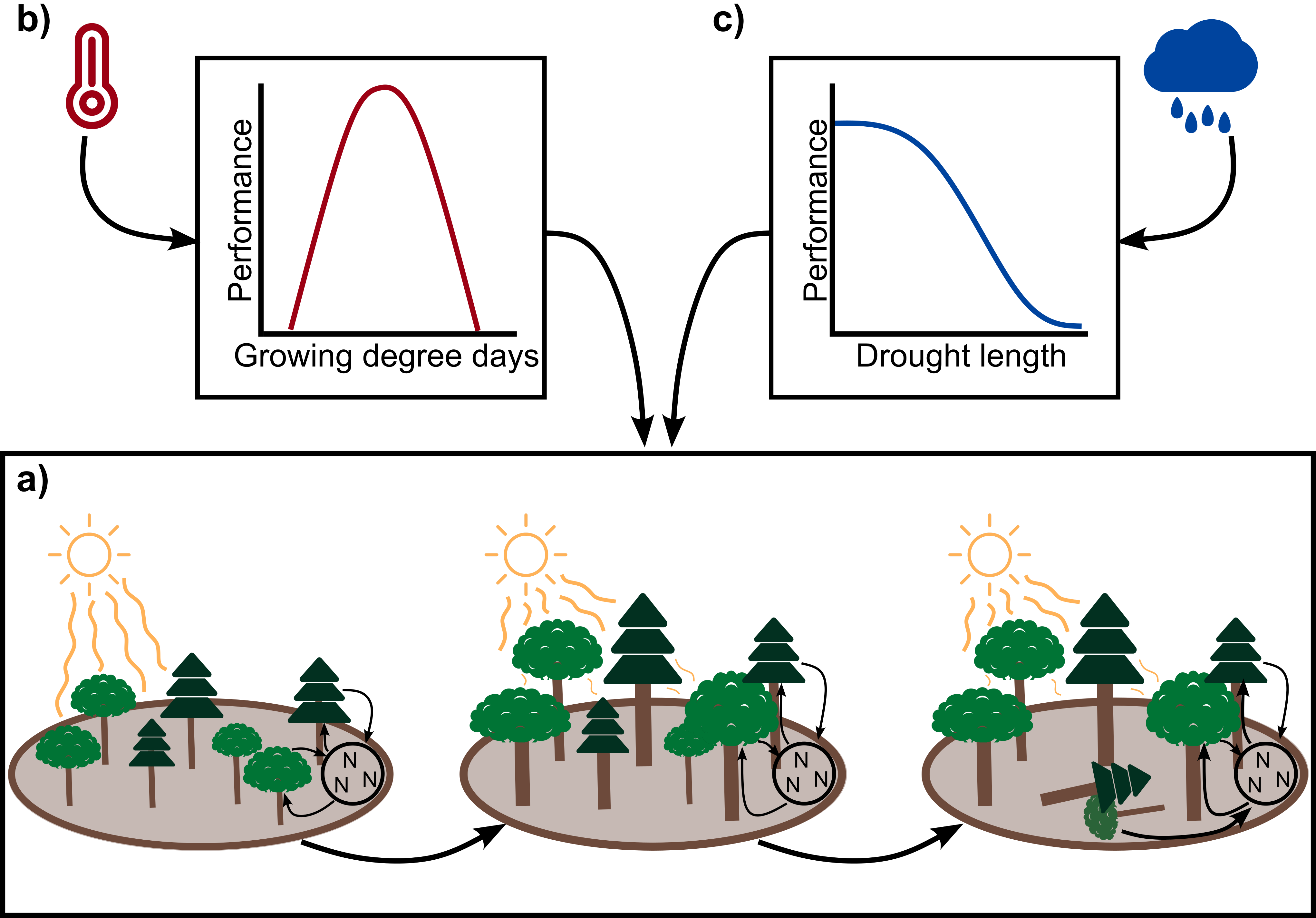
I implemented the paradigm of “model-data fusion as hypothesis testing” in a case study of temperate forest ecosystems in the northeastern U.S. by confronting a forest gap model, LINKAGES, with 50 years of empirically estimated aboveground biomass. This study system is interesting because many of the tree species in this region are near their historical range limits, leading to questions about the relationship between species’ climate niches and individual tree phsyiological tolerances to climatic variation. I found that the representation of the relationship between climate and individual tree growth in LINKAGES is unsupported by empirical data. I traced this to LINKAGES’ hypothesis that tree growth will be consistently reduced near the species’ range limits. This indicates that our understanding of how individual tree climate tolerances scale up to the relationship between climate and species range limits is oversimplified, highlighting a need to incorporate more physiological detail on climate-tree growth relationships in this forest model.